Truck & Car Guides / Trailers & loads
Car haulers: how vehicles get to the dealership
Car haulers fit a parking lot's worth of vehicles onto one rig. Here is how stinger and high-mount carriers work, the jobs they do and why the work takes real skill.
A puzzle on wheels
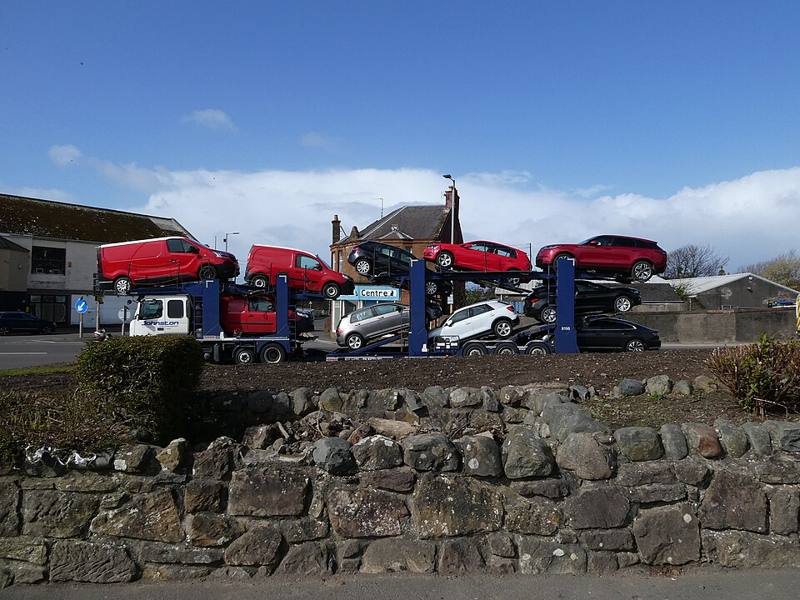
A car hauler (auto transporter) carries finished vehicles from factories, ports and rail yards to dealerships, auctions and customers. Fitting as many vehicles as possible onto a rig, within height, length and weight limits, is a three-dimensional puzzle. Every hydraulic deck, ramp and tilt position matters.
Types of car haulers
Stinger (low-mount)
The tractor's fifth wheel sits very low, behind the drive axles, and the trailer's front end hangs over the tractor. A car can ride on a rack over the tractor cab, and more on the trailer's upper and lower decks. Stingers maximize capacity and are common on new-vehicle routes. They typically carry somewhere around 7 to 10 cars depending on vehicle size and the rig's design.
High-mount
A high-mount uses a regular fifth wheel position with a trailer that has its own upper and lower decks. Because the tractor is a standard truck, it is more flexible, but usually carries fewer vehicles than a stinger.
Wedge and hotshot trailers
Smaller operators often use a pickup or medium-duty truck pulling a gooseneck wedge trailer that carries around three or four cars. These are popular with owner-operators doing dealer trades, auctions and individual customer moves.
Enclosed transporters
Fully enclosed trailers protect exotic, classic and race cars from weather and road debris. Many have liftgates instead of steep ramps so low cars can be loaded without scraping.
How loading works
- Plan the order: delivery stops are planned so the first car off is the easiest to reach. Unloading one car at stop two should not require moving five others.
- Set the decks: hydraulic cylinders raise and tilt individual decks and ramps.
- Drive each vehicle on: carefully, at walking speed, with clearance checked on both sides and above.
- Secure each vehicle: usually with wheel straps (tire nets) or chains attached to designated points. Each wheel strap holds the tire to the deck so the car's suspension still works.
- Check height: the final load must stay within the height limit for the route, commonly around 13 feet 6 inches in many states, though rules vary.
Damage inspection
Car hauling is all about the condition of each vehicle. At pickup the driver walks around every car and notes every scratch, ding and chip on a condition report or bill of lading, often with photos. At delivery the receiver checks again. Any new damage can come out of the carrier's pocket, which is why careful drivers are valued.
Photos with a timestamp of all four sides, the roof and the wheels at pickup are a car hauler's best friend in a damage dispute.
Weight and height challenges
A load of large pickups or SUVs can hit weight limits long before every slot is filled. Electric vehicles are typically heavier than gas models of similar size, which can reduce the number a rig can legally carry. Drivers balance weight across the steer, drive and trailer axles while keeping the overall height legal. See weight limits and the bridge formula.
Car hauler vs other freight
| Car hauler | Dry van | |
|---|---|---|
| Loading | Driver loads and secures | Usually shipper loads |
| Number of stops | Often several dealers | Often one or two |
| Physical work | Climbing decks, strapping | Minimal |
| Damage risk | High and visible | Lower |
| Pay | Often higher | Baseline |
Is it for you?
Car hauling suits detail-oriented drivers who do not mind climbing, working in all weather and handling expensive vehicles under time pressure. Many carriers require experience before training drivers on a stinger. Owner-operators with wedge trailers can run their own small auto transport business, with the insurance and authority that requires. See owner-operator vs company driver.